Gilgamesh Tablet XI — The Flood Story
Cuneiform name: GIŠ.BIL.GA.MEŠ (𒄑𒉈𒂆𒈦) — "The Ancestor is a Hero" (Sumerian for Gilgamesh) / ŠA.NE.GA (𒊭𒉈𒂵) — "Flood"
Tablet: Gilgamesh Tablet XI — British Museum K.3375 (from the Library of Ashurbanipal, Nineveh)
Date: c. 650 BCE (Neo-Assyrian copy); the Standard Babylonian version of the Epic of Gilgamesh dates to c. 1200 BCE; the flood story appears already in Old Babylonian versions c. 1700 BCE
Location: Nineveh, Library of Ashurbanipal, Kouyunjik mound (modern Mosul, Iraq)
Current location: British Museum, London
CDLI Link: https://cdli.earth/cdli-tablet/3374 (Tablet XI)
CDLI Photo: 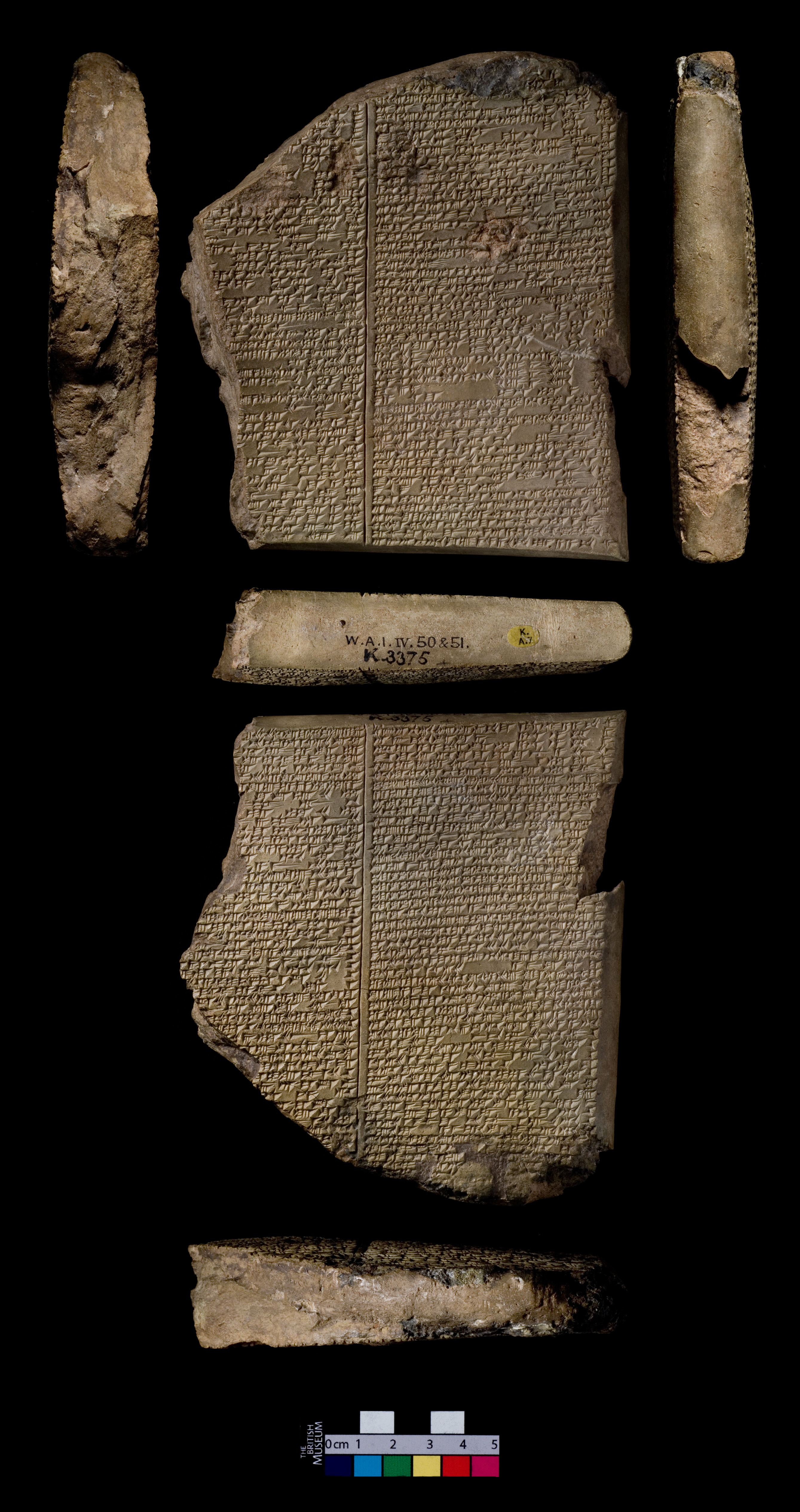
The Tablet
K.3375 is a well-preserved clay tablet from the library of King Ashurbanipal at Nineveh, inscribed in Neo-Assyrian script. It contains the eleventh tablet (Tablet XI) of the Standard Babylonian Epic of Gilgamesh — the climactic flood story. The tablet measures roughly 6 by 8 inches and is in excellent condition, with most of its six columns fully legible, though minor chips affect a few lines. It was discovered by Hormuzd Rassam in the 1850s and first published by George Smith in 1872, whose announcement of a Babylonian flood story "antedating the biblical account" caused a sensation in Victorian England.
The Text (Scholarly Translation)
Tablet XI opens with Gilgamesh — grieving the death of his friend Enkidu and obsessed with mortality — seeking Utnapishtim, the only human granted immortality. After a perilous journey, Utnapishtim tells Gilgamesh the story of the flood. The gods, led by Enlil, decide to destroy humanity. But Ea (Enki) warns Utnapishtim:
"O man of Shuruppak, son of Ubara-Tutu, Tear down the house, build a boat! Abandon riches, seek survival! Spurn property, save your life! Take up into the boat the seed of all living creatures!" (Tablet XI, lines 23–27, after George's translation)
Utnapishtim builds a colossal boat: a cube, six decks high, 120 cubits on each side (roughly 180 feet/55 meters). He loads it with his family, craftsmen, and "the seed of all living creatures." The flood comes:
"For six days and seven nights The wind blew, the flood, the tempest overwhelmed the land. When the seventh day arrived, the tempest, the flood, The battle which had been raging like an army, subsided." (Tablet XI, lines 127–131)
The boat comes to rest on Mount Nimush (commonly identified with Pir Omar Gudrun in Kurdistan). Utnapishtim sends out a dove, then a swallow, then a raven. When the raven does not return, he knows the waters have receded. He makes a sacrifice, and the gods — famished for the offerings that only human worship can provide — gather around. Enlil is furious that some survived, but Ea defends the choice. Enlil blesses Utnapishtim and his wife and grants them immortality, settling them "far away, at the mouth of the rivers."
Sitchin's Interpretation
Sitchin saw the Gilgamesh flood account as yet another witness to the same historical event recorded in Atra-Hasis — with the details streamlined for the epic's narrative purposes. For Sitchin, the story's power lay in its close correspondence to the biblical flood:
- Both feature a hero warned by a god to build a boat.
- Both involve saving family and "the seed of all living creatures."
- Both describe a multi-day flood covering the mountains.
- Both end with a bird release (dove/raven) and a sacrifice upon emerging.
Sitchin emphasized that the Gilgamesh version was written down at least 500 years before the earliest known draft of Genesis, and likely drew on sources — like Atra-Hasis — that were a thousand years older still. He argued this proved that the biblical author (traditionally Moses) was not writing divine revelation but adapting existing Mesopotamian flood traditions — traditions the Anunnaki themselves had originated.
Sitchin also seized on the detail of the boat's dimensions: a perfect cube, which he argued made no sense for seafaring but was a perfect "stability design" for a submersible or water-tight survival vessel. In Sitchin's view, this supported his theory that the Anunnaki designed and supervised the construction.
Analysis
Mainstream scholars fully accept that the Gilgamesh flood story predates the biblical account and shares a common Mesopotamian source tradition. The discovery of the tablet by George Smith in 1872 — culminating in his dramatic reading before the Society of Biblical Archaeology — was a watershed moment in biblical criticism, and no serious scholar today disputes the genealogical relationship. The areas of agreement between Sitchin and mainstream scholarship on this tablet are thus unusually wide. The divergence lies in interpretation of origin: scholars see the flood story as a Mesopotamian cultural myth that spread through the ancient Near East via trade, migration, and conquest; Sitchin sees it as distorted historical memory of an actual Anunnaki-engineered catastrophe. Additionally, Sitchin's claim that the cubic boat was a submersible vessel with Anunnaki technological input is speculation unsupported by the text — the Akkadian description of the boat as a kuppu'u (a "round" or "coracle" design in the older Atra-Hasis version) suggests development over time, not a single sealed cube. But the tablet's importance as an independent witness to a pre-Genesis flood narrative is beyond dispute.
See Also
- The Great Flood — Evidence analysis of the flood story
Sources
- CDLI entry: https://cdli.earth/cdli-tablet/3374 (Tablet XI)
- George, A. R. (2003). The Babylonian Gilgamesh Epic: Introduction, Critical Edition, and Cuneiform Texts. Oxford University Press. (The definitive scholarly edition.)
- George, A. R. (1999). The Epic of Gilgamesh: A New Translation. Penguin Classics. (An accessible modern translation.)
- Smith, G. (1872). "The Chaldean Account of the Deluge." Transactions of the Society of Biblical Archaeology, 1, 213–234. (The original publication that announced the discovery.)
- Sitchin, Z. (1976). The 12th Planet. Bear & Company. (Chapter 9 discusses the Gilgamesh flood.)
- Sitchin, Z. (1985). The Wars of Gods and Men. Bear & Company. (Further Anunnaki-centered interpretation of the flood.)